On Pitching
The world doesn’t care about your idea; it might care about your story.

Last week, I gave a lecture at Capilano University on how to pitch. The students were told I was there because I’ve raised money and done a few things here and there. That’s technically true. The whole truth is less glamorous.
Startups, nonprofits, politics, community projects — I’ve been rejected in all of them. Spectacularly. Repeatedly. And for some reason, that makes you a “guest lecturer.”
Pitching isn’t about money. Pitching is how you approach life.

A pitch is simply this: you stand in the present and show people two futures.
The default future – what happens if we keep doing what we’re doing.
The impacted future – what happens if we do the hard, specific thing you’re asking for.
If you believe your role here is to make even a small dent in the universe, you don’t get to sit this out. You have to learn to show people those two futures clearly enough that some of them decide to come with you.
If you resign yourself to the default future, you invite a slow poison: resentment, jealousy, hopelessness.
“Why them, not me?”
“Why does nothing ever change?”
“Why do my ideas never land?”
This is a story about why that happens — and what to do about it.
The bad news: the world does not reward novelty or good intentions
For most of my life, I believed the world rewarded us simply for creating things that we see as good.
If I had a smart enough idea, if I worked hard enough, if the timing was “meant to be,” things would fall into place. That had to be the formula… right?
Startups, advocacy, community work, politics, partnerships — I thought the quality of the idea would speak for itself.
I’ve come to tell you: it didn’t. And it won’t.
For a while, that reality wrecked me.
I blamed people. I resented “luckier” founders. I judged people who were worse on the merits but “somehow” made their own dreams come true.
Spoiler alert: that makes everything worse.

Recently, I started asking a different question:
What if the problem wasn’t them?
What if the problem was how I was telling the story of my ideas?
There is a default future. There are also infinite other futures being built right now by people who are not waiting to be discovered and not just explaining their ideas.
They are telling stories that bring people together in common cause.
My hope is that this helps you find your rallying cry — your pitch — for a community that doesn’t exist yet, but could.
To get there, we need to kill three bad stories we tell ourselves about the future.
Most of us carry some mix of three models for how change happens:
The Academic Brain – “If it’s true and new, they’ll care.”
The Destiny Myth – “If it’s meant to happen, it will.”
The Manifestation Trap – “If I think the right thoughts, it will come.”
All three contain a seed of truth. All three fall apart in the room where real people make real decisions.
1. The Academic Brain: “If it’s true and new, they’ll care.”
This is the inheritance from school. Academic courses are led by people who are paid to care about your ideas. In the real world, you won’t be so lucky.

This thinking is rooted in the simplicity of: If I show you enough facts, enough detail, and something novel, you’ll have to agree this matters. Add citations and a graph, and I’ve done my job.
In practice, this looks like:
Twenty slides of context before anyone knows why we’re here
Deep technology explanations before anyone feels a problem
Lists of features instead of a clear sense of what changes for a real person
The problem isn’t truth or novelty. The problem is that your audience has limited attention and needs to feel something in order to change.
This approach doesn’t respect your audience’s time or make them feel anything. All you’ve done is make it about you.
Your audience is tired. They’re busy. They’ve seen a hundred decks before yours. Their first thought is never:
“Wow, someone has a new idea!”
It’s:
“Why should I care?”
If they can’t answer that in the first minute, you’ve lost them.
Something becomes valuable when it changes how people understand a problem they already care about.
Academia rewards novelty. Real life rewards relevance. Be relevant.
2. The Destiny Myth: “If it’s meant to happen, it will.”
This one sounds wise. It isn’t.
“If it’s meant to be, it will be.”
“If the timing is right, the right people will find it.”
“If I just keep my head down and do good work, someone will notice.”
Yes, timing and luck matter. Some things really are outside of our control.
But lean on this too hard and you quietly outsource your agency. You become a spectator in your own life, waiting to be discovered instead of learning how to show up and speak clearly about what you’re building.
Your ideas don’t get “found.”
They get carried into the arena — often shakily, imperfectly — by you.
3. The Manifestation Trap: “If I manifest it, it will come.”
Some believe that if you just get your energy right, the universe will deliver.

A grounded internal state helps. Hope matters. Despair is not a strategy.
But mindset is not a replacement for craft.
You can journal, visualise, and manifest all day. If you can’t explain your idea in a way that plugs into the world as it actually is — power structures, fears, incentives, constraints — your “future” stays in your head.
Here’s the uncomfortable bit:
The flow of positive outcomes is not linear.
All changes are hard-fought in the arena where we tell the story of our lives.
The Academic Brain, Destiny, and Manifestation all try to skip that arena.
They avoid the messy, human work of translating:
“I see a better world”
into:
“Here’s the story that makes that world feel necessary, now, for you.”
So what is the right approach?
How to make an impact: zeitgeist thinking
The shift is this: stop thinking like a scientist defending a thesis. Start thinking like someone walking into a conversation that’s already happening.
That conversation is the zeitgeist — the spirit of the moment your audience is living in.

Every audience is already inside a story:
Problems they already care about
Language and metrics they already use
Fears they whisper and hopes they barely admit
When you pitch your startup, your project, or your next chapter, you are not shouting into a void.
You are stepping into this existing story and trying to move it forward.
That’s zeitgeist thinking: You don’t just have an idea. You have a story that plugs into what’s in the air for a specific community, at a specific time — and moves it.
When I teach pitching, I talk about three lenses:
Presence – how you actually show up in the room: eyes, breathing, posture, whether you look like you want to live in the future you’re describing.
Story – who’s the hero, who’s the villain, what journey they’re on, and what’s at stake.
Value – the currencies your audience actually trades in: money, risk, time, power, impact, optionality.
Zeitgeist thinking worships stories and value because stories and value persuade us. 98% of decisions are made emotionally. Do not try to change human nature. Use it to tell the story of the future.
To see this in action, let’s learn from the greatest pitch ever made.
The greatest pitch ever made
Year: 1863.
Context: the American Civil War. Mass death. A nation unsure whether it deserves to exist.
Occasion: dedicating a cemetery on the battlefield of Gettysburg.
Objective: Abraham Lincoln must pitch continuing the war when people have already given up so much.
Audience: the families of those who have already lost loved ones to the war effort.
The audience is grieving, exhausted, and unsure if this experiment of “a nation conceived in liberty” is worth all this blood.
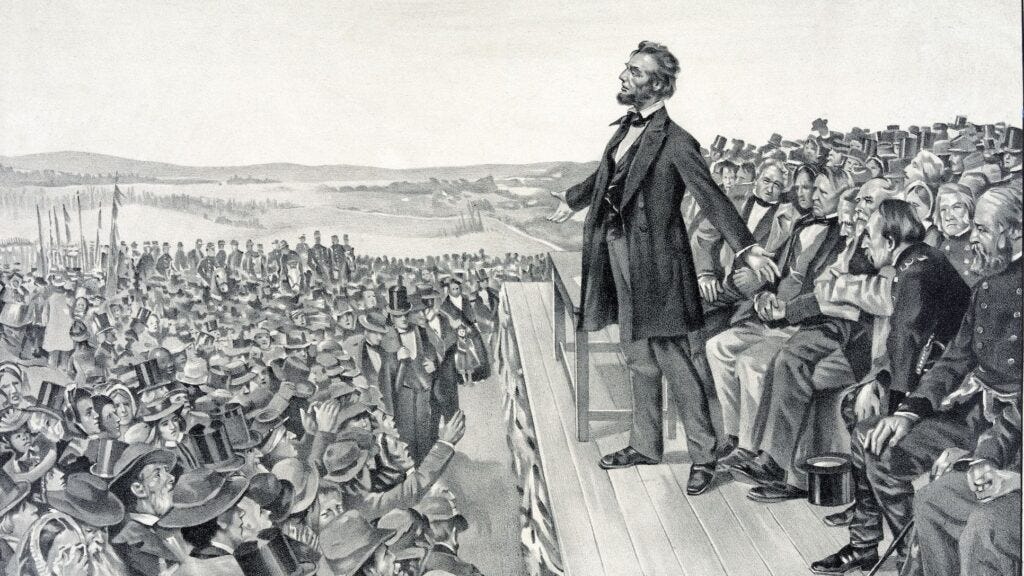
Abraham Lincoln speaks for about two minutes.
No deck. No charts. No “three key reasons.” No ten-year forecast.
That speech, the Gettysburg Address, has outlived almost everything else written that decade.
Why?
Because it’s not just a speech. It’s a pitch. A pitch that turned Lincoln’s vision into reality within months of giving it.
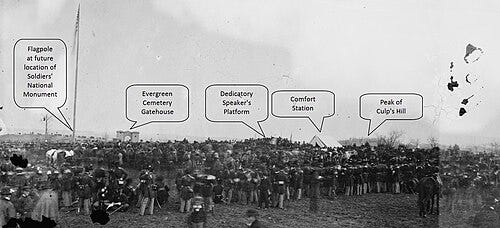
Lincoln does a few crucial things in his speech:
He plays with time.
Past: “a new nation, conceived in liberty.”
Present: “a great civil war, testing whether that nation… can long endure.”
Future: “a new birth of freedom.”He honours the emotional arc.
Birth → death → rebirth. He doesn’t skip the horror or the graves; he moves through them.He names layered problems.
Nation-level: Can democracy survive at all?
System-level: Can government “of the people, by the people, for the people” endure?
Personal: What are we, the living, supposed to do now?He transforms the audience.
They arrive as spectators at a ceremony.
They leave as stewards of an “unfinished work.”
That’s a pitch. Stripped down, the template looks like this:
Past: Here was the original promise.
Present: Here is the crisis testing that promise.
Future: Here is the renewed promise, if we choose it.
Ask: Here is the role you must play.
Barack Obama’s best speeches riff on the same structure: a story of self, a story of us, and a story of now. Who am I, who are we, and what this moment demands. That’s zeitgeist thinking at national scale.
Now let’s zoom all the way back down. No nation. No battlefield. Just an unremarkable founder with a bad deck.
My failed deck, and how trust changed everything
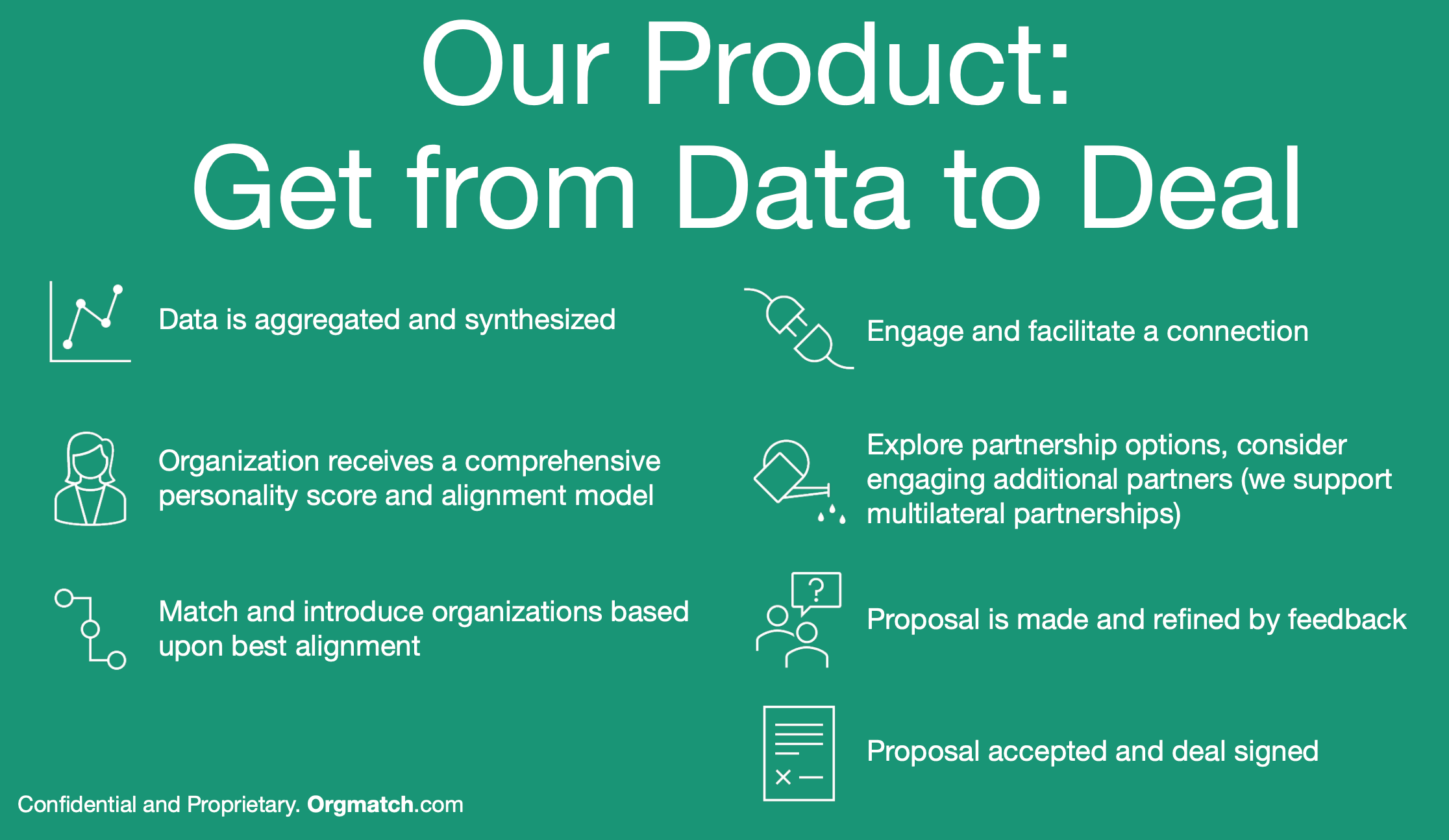
In 2021, I founded a startup called Orgmatch.
My first pitch deck was built in full Academic Brain mode. The core idea was:
It’s hard to find the right partners to bring ideas to life.
True. Supported by experience. Novel enough.
So I did what a lot of founders do:
Built a deck that checked all of the boxes
Started with background and market context
Walked through the product and the matching engine
Tried to prove I had seen all the data and all the edge cases
People were polite. They “got it.” They asked a few clarifying questions.
But you could feel the room disappear.
I was pitching like this was an exam for a professor who was paid to care about my thoroughness — not a group of humans scanning for “Why should I care?” in the first thirty seconds.
When I did get feedback, it was always about how to tweak the slides.
“Move this graph earlier.”
“Add a traction slide.”
“Make the font bigger.”
Nobody once said the thing that I actually needed to hear:
“Throw this out and start over. Tell me a story.”
Over time — through a lot of feedback, some hard lessons, and a few mentors who were willing to be blunt — I realised something:
The idea behind Orgmatch wasn’t really about matching.
It was about trust.

We live in a world that is losing trust.
Institutions are fraying. People are burned by bad partnerships, broken promises, performative collaborations.
And yet we still need each other to do anything that matters.
So we rebuilt the pitch around that.
Not:
“Here’s a novel way to match organizations.”
But:
“We’re living through a collapse of institutional trust. What if we could recover it on purpose?”

The story became:
Past promise: Institutions and partnerships carried an implicit promise of stability and shared purpose.
Present crisis: That promise has been broken. People waste time in bad collaborations or avoid collaborating altogether. Everyone feels it.
Future: Imagine a world where you actually know who to trust, and why — and where the right partners can find each other quickly enough to matter.
Ask: Help build the infrastructure that recovers this trust.
Same underlying product. Completely different story.
The reaction in and outside of the rooms that I was pitching in changed:
We attracted clients.
I was invited to speak at conferences.
We joined top accelerators.
We met serious investors.
By getting rid of the “proper” slides and telling a narrative story — exactly what founders are usually told not to do — we unlocked a better future for ourselves.
People leaned in.
They started sharing their own stories: projects that went sideways, trust that had been broken in their field, the emotional and financial cost of misaligned partnerships.
“Is solving this really possible?” they’d ask.
To which I could say: “Let’s have coffee.”
That’s the other side of the pitch.
It’s not the whole relationship. It’s the gateway.
Your job in a pitch is not to download your brain.
Your job is to spark enough curiosity that the right people can imagine themselves on your team — and then you earn that trust over time.
The world didn’t care that my idea was new.
It cared that I could name a wound it already felt — broken trust — and offer a credible path toward healing it. Once I started pitching that, it unlocked the rest.
You are the guide. They are the hero.
The best stories follow the hero’s journey. If it works for Disney, it will work for you.

When I tell students this, they immediately cast themselves as the hero. The protagonist. The chosen one.
They’re not. Neither am I.
We are the guides.
Your audience — voters, investors, donors, customers, collaborators — they are the protagonists in your story.
Your job is to guide them and hand them the gift that will slay the villain and transform the future, so they can return to the world as it should be.
Here’s the biggest shift that I can offer you, whether you’re pitching a startup, a project, or the next phase of your life:
You are not the protagonist in your pitch.
You are the guide.
The protagonist is the person you’re asking to act.Your investor, your customer, your future employer, your community — they are the hero in your story.
Your work:
Name their ordinary world.
A day in their life before anything changes: the constraints, the frustrations, the quiet questions.Name the villain.
Not “the system” in abstract, but something specific that hurts them:
– The spreadsheet that crashes the night before the board meeting.
– The permitting rule that delays a climate project by 18 months.
– The idea that never leaves the notebook.Show you understand their failed attempts.
They’ve tried existing tools, strategies, or hacks. You see why those aren’t enough.Arrive as the guide, not the hero.
You bring tools, knowledge, and support — but you don’t erase the work they have to do.Walk them through the trials.
Implementation, bumps, experiments, learning curves.Return with the elixir.
Their world after:
– Measurable gains (money, time, risk, impact).
– Emotional gains (confidence, pride, relief, dignity).
This is the hero’s journey applied to strategy:
Hero: them
Villain: the friction that keeps them small
Guide: you
Elixir: the value you deliver in their real currencies
Everyone has dignity as a human being.
But we only display that dignity through the story we tell with our lives.
When you pitch, you’re not just asking for money or permission.
You’re inviting someone to step into a more dignified version of their own story.
You’re creating a new, better future for them.
A simple exercise to start your idea
If you’ve read this far, you probably have an idea that won’t leave you alone.
A company. A project. A policy. A piece of art. A move you want to make in your life.
Before you close this tab, write a one-paragraph version of your own Gettysburg pitch:
Past – The original promise
“Once upon a time, this field / community / customer set out to ______.”
Present – The crisis
“Today, that promise is being tested because ______.”
Future – The renewed promise
“If we succeed, we get a new birth of ______ (what value / fairness / dignity is restored?).”
Hero & villain
“Who is the hero in this story, and what specific villain are they up against day to day?”
Your role as guide
“What do you bring that helps them make the jump?”
You don’t need to show it to anyone yet. But write it. Get it out of your head and into language.
Because here’s the thing:
If you have even one idea for a better future, you don’t get to leave it to fate.
You don’t get to hide behind novelty.
You don’t get to wait until the universe sends a clearer sign.
Progress is non-linear.
Nobody is coming to do this for you.
You are already in the arena.
A note of thanks
None of this is purely mine.
I’m stitching together ideas I’ve been lucky enough to learn from others. Core among these:
Adam Frankl and the Alchemist Accelerator, who sharpened how I think about storytelling and pitches using the method of the Hero’s Journey;
Larry McEnerney and his legendary teaching on writing for real readers, not imaginary ones (and for making his lessons — including the one that taught me most of what I know about Gettysburg — available online for free);
Marshall Ganz for his framework of a Story of Self, a Story of Us, and a Story of Now;
Daniel Kahneman for his Nobel Prize–winning research and book Thinking, Fast and Slow;
Mel Robbins for her book Let Them; and
Of course, Sean Bickerton, who made me write this all down and present it to his class in the first place (and for his gifting to me of The Story Grid).
And from the countless mentors, colleagues, and students who have loaned me their time, their trust, and their patience as I’ve learned.
Thank you for letting me pay it forward.
Nicely done, Trevor. Made me rethink my pitch!